Mechanochemistry: a promising route to phosphorus-based and bio-based flame retardants
Milling solid reactants for about one hour, at room temperature and without organic solvent, can graft phosphorus onto cellulose and tannins. Why phosphorylation matters for flame retardancy, what mechanochemistry brings to phosphorus chemistry, and the fire performance of three bio-based flame retardants developed at Materia Nova.
 Dr. Fouad Laoutid · Flame retardancy of polymers & composites
1. Mechanochemistry in brief
Mechanochemistry uses mechanical energy, most often by milling, to drive chemical reactions with little or no solvent. Solid reactants are placed in a jar with grinding balls; impacts and friction create fresh surfaces, bring the reactants into intimate contact and locally supply the energy needed for the reaction. IUPAC has listed it among the ten chemical innovations most likely to make chemistry more sustainable.
The tools range from laboratory mills (vibratory or planetary, from milligrams to around a hundred grams) to continuous processes: twin-screw extrusion and agitator bead mills, which already process several kilograms per hour in the pharmaceutical, pigment and materials industries (Figure 1).
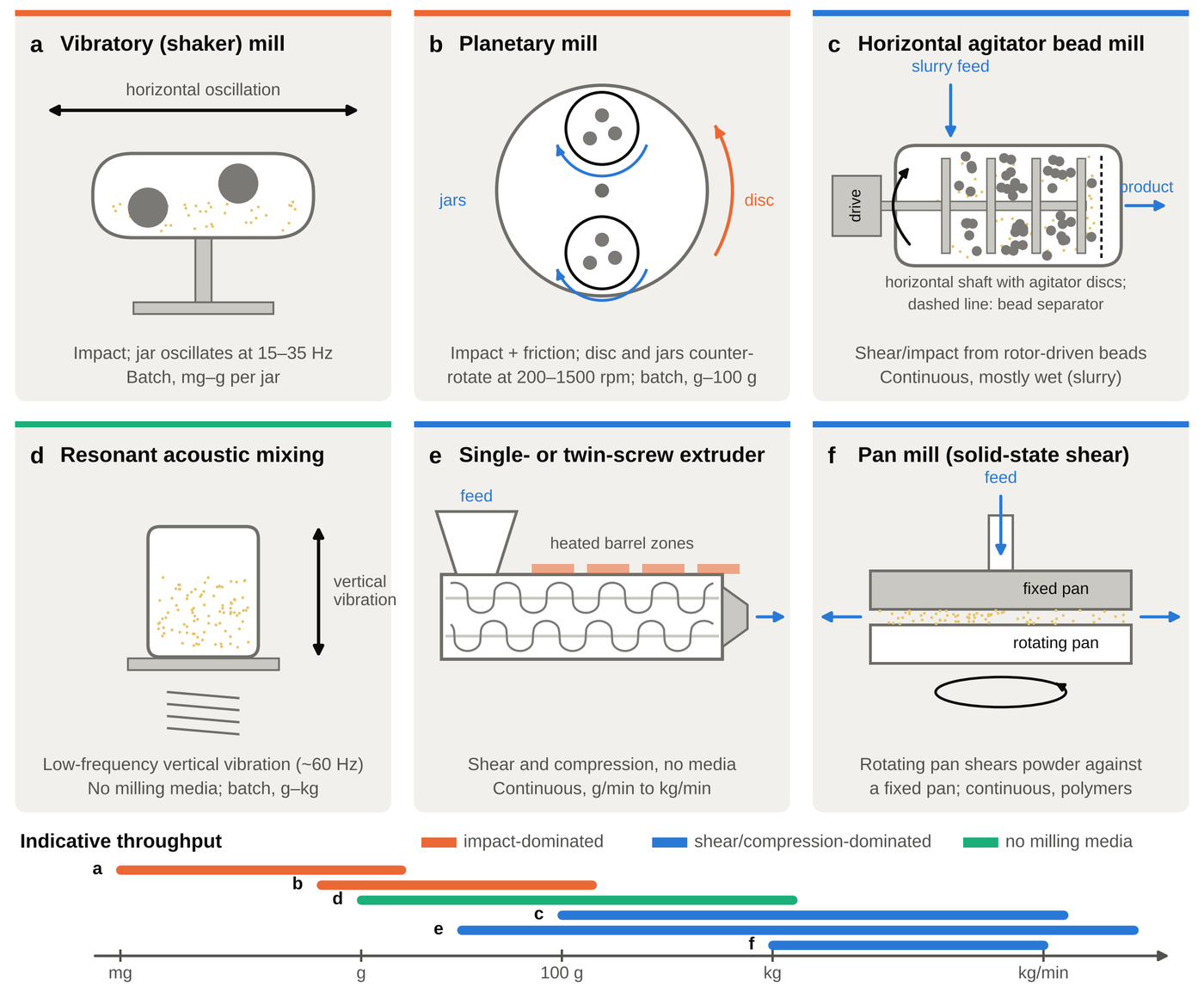
For industry, the benefits are threefold: no or far less solvent, short reaction times, often around one hour, and reactions that can run at room temperature. Milling also makes insoluble solids react, something solution chemistry does poorly.
2. Why phosphorylation is at the heart of flame retardancy
With the restrictions on some halogenated flame retardants and, more recently, on boron compounds and melamine, phosphorus-based systems have become the main alternative. Their efficiency relies on two modes of action. In the condensed phase, they release phosphoric and polyphosphoric acids on heating, which dehydrate the polymer and promote the formation of a protective char. In the gas phase, some phosphorus species trap the radicals that sustain the flame.
Phosphorylation consists in grafting phosphate or phosphonate groups directly onto a molecule or a polymer. In biopolymers rich in hydroxyl groups, such as cellulose, lignin or tannins, the grafted phosphorus groups promote char formation and improve its resistance to thermo-oxidative degradation.
3. What mechanochemistry brings to phosphorus chemistry
Outside the fire field, mechanochemistry has already given access to phosphorus compounds that are difficult, or even impossible, to obtain in solution:
- phosphites and phosphonates prepared directly from condensed phosphates, without going through white phosphorus;
- the orthophosphite anion, never isolated in solution;
- α-aminophosphonates and sterically hindered phosphazanes, obtained without solvent or catalyst;
- the reduction of poorly soluble phosphine oxides in 99% yield, compared with 36% in solution.
Phosphonates, phosphoramidates, phosphazenes and phosphine oxides are precisely the building blocks of many commercial flame retardants. Transferring this toolbox to flame retardants is one of the most promising directions in the field.
4. Cellulose and tannins phosphorylated by milling: remarkable fire performance
At Materia Nova, we have applied this approach to two families of abundant, low-cost biomolecules, cellulose and tannins, by milling them with P2O5 for about one hour, at room temperature and without organic solvent[1–3].
- Phosphorylated cellulose. At 30 wt% in polypropylene, it reduces the peak heat release rate by 30%, whereas unmodified cellulose increases it[1].
- Pre-carbonised cellulose. Increasing the proportion of P2O5 yields a porous carbon very rich in phosphorus (17 wt%): at only 12.5 wt% in polypropylene, it reduces the peak heat release rate by 55% and spreads combustion over a period two and a half times longer[3].
- Phosphorus–potassium tannins. A phosphorus–potassium salt of tannic acid, prepared in one hour instead of sixteen hours in chloroform by the conventional route, reduces the peak heat release rate of polypropylene by 78% and forms an expanded, cohesive char[2].
These results show that a short, dry process without heating can turn renewable resources into efficient flame retardants. The next steps are the transfer to continuous processes and a full assessment of the environmental benefit, including washing and energy.
References
- Aaddouz M., Laoutid F., Mariage J., Lazko J., Yada B., Mejdoubi E.M., Toncheva A., Dubois P. Facile preparation route of cellulose-based flame retardant by ball-milling mechanochemistry. Molecules 29 (2024) 6065. doi:10.3390/molecules29246065
- Aaddouz M., Laoutid F., Mariage J., Yada B., Toncheva A., Lazko J., Azzaoui K., Sabbahi R., Mejdoubi E., Saeb M.R., Dubois P. Mechanochemistry for the synthesis of a sustainable phosphorus/potassium tannic acid flame-retardant additive and its application in polypropylene. ACS Sustainable Chem. Eng. 13 (2025) 1450–1459. doi:10.1021/acssuschemeng.4c04952
- Dropsit S., Lazko J., Landercy N., Dubois P., Laoutid F. New insights into solid state phosphorylation of cellulose for the development of bio-based flame retardant. Polym. Degrad. Stab. 242 (2025) 111632. doi:10.1016/j.polymdegradstab.2025.111632